Опасная зона

Опасная зона

Monday, May 28, 2012

North Korean Concentration Camps

I wanted to add a note to my previous post about the Korean DMZ:

On Wikipedia there are a few entries about some of the concentration camps in North Korea, certainly worth reading, it will surely ruin your day.
  • Camp 14 - Kaechon internment camp
  • Camp 15 - Yodok concentration camp
  • Camp 18 - Bukchang concentration camp
Update: see also this list of known concentration camps on wikipedia, and an article about human rights in North Korea.

The existence is reported by eyewitnesses. The trustworthy newspaper The Guardian brought this article about Shin In Geun who was born in Camp 14 and actually managed to escape.

It is simply outrageous that these crimes persists for decades without any real progress. I recall the discussions about why German concentration camps were not attacked, even that allies were aware of the crimes that took place there. Again, Wikipedia summarizes this issue in the "Auschwitz Bombing Debate".

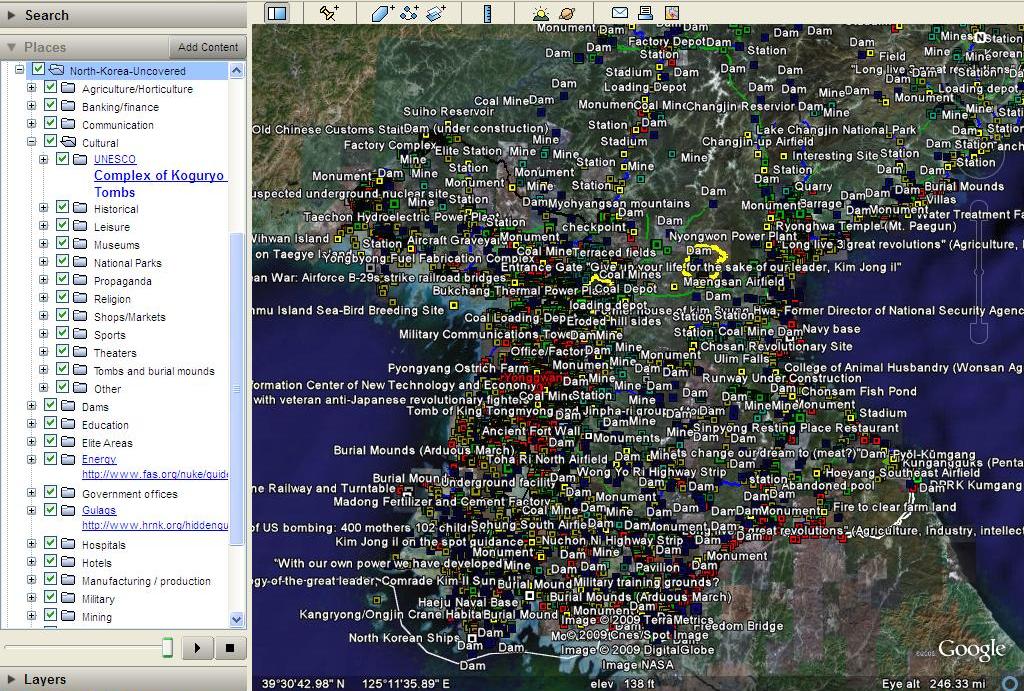
If you find Google Maps and Google Earth too void when viewing North Korea, you may want to download a Google Earth addon found here.

Let there be light.


Obviously, any violent intervention with North Korea may result in even worse tragedies, I'll just mention North Korea is one of the most militarized countries, and have a stockpile of chemical and biological weapons, and a nuclear weapons program with an unclear status.

I have no clue what to do about it, but it's a disaster that this condition is retained for decades, apparently with no improvements.

WTF.


Friday, May 25, 2012

A Tour Into the Demilitarized Zone of Korea

May 2012 I was off to Seoul attending at the PTCOG 51 conference on particle therapy. Guess I was kind of disappointed, it turned out to be a rather dull seance with poor speakers, minimal discussions, and as usual the poster session was missing.

After the conference I and Linda went for one of the full day tours visiting the Korean demilitarized zone (DMZ) between North and South Korea. Fliers offering this tour are available in most hotels, and the price is around 100 €.

I have been following the North Korean tragedy for several years, YouTube is full of videos documenting their plight, see the links at the end of this post.

North and South Korea. The DMZ tour took place in the marked region.

Tour concentrated on a region just 20-30 km north of Seoul.

The five points of interest we visited during the DMZ tour. The gray line is the border (Military Demarcation Line). The brownish line to the left of it shows the South Korean DMZ perimeter. The North Korean counterpart is less obvious here.

In this region we visited five points of interest (in that order):
  1. The "Freedom bridge"
  2. The "3rd infiltration tunnel"
  3. An observation post with good view over North Korean territory
  4. Dorasan railway station
  5. and the highlight, the Joint Security Area, or JSA
Visiting the JSA required a number of precautions to be taken, a few quotes from the leaflet:
  • "When you arrive at Conference room, do not touch any equipment such as microphones or flags belonging to the communist side."
  • "Do not speak with, make any gesture toward or in any way, approach or respond to personnel from the other side."
  • "Casual clothes such as ripped jeans, sleeveless shirts, mini skirt, short pants, military cloth and sandal (slippers) are not permitted in the tour area."
  • and especially "Shaggy or unkempt hair is not allowed either." which meant we had to find a scarf for Linda's shaggy hair.
Linda got a neutral looking scarf to cover her shaggy hair during the JSA visit.
A bus picked us up at our Hotel, and as we proceeded towards the north going along the river, where we could see ample amounts of barbed wire fences and South Korean observation posts at regular intervals. As we got closer, the number of guards increased and we saw tank blocks and plenty of checkpoints.

Observation post with armed South Korean guards.
Arriving at point (1) we saw the freedom bridge and a battered train from the Korean war.  And looooooots of tourists. Got about 30 minutes for this part.

Freedom bridge leading into the DMZ.

Next we progressed to point (2) which was the 3rd infiltration tunnel. Four tunnels in total were discovered, build by North Koreans, three of them can be visited by tourists. According to our guide intelligence agencies suppose more than 20 undiscovered tunnels under the DMZ. No idea if this is really true, though. I thought it should be pretty easy to detect the digging with sensitive microphones or seismometers. Or can one really dig through the granite using dynamite undiscovered? Well..

Garden and a minefield. Notice the red triangle on the fence, saying "Mine".
No picture taking was allowed in the tunnel, but at the tourist site, a nice garden could be seen. Just behind the barbed wire fence: minefields.
The DMZ is approximately 4 km wide with the Military Demarcation Line (MDL) at the middle of it. Beyond the DMZ a heavy militarized area is found, on both north and south side. American and South Korean troops guard the southern side.
The entire area is full of mines. We saw those little red "MINE" tags everywhere. Wonder if some of those mines are exposed due to natural erosion, and perhaps even washed away.. outside of the marked areas? Hm.

Mine.

Mine. Mine. Mine.

Mine.
The tunnel was rather a rather unspectacular sight. Nothing I really would recommend others to visit. After a long walk deep underground we saw a steel door and some sign marking the MDL.

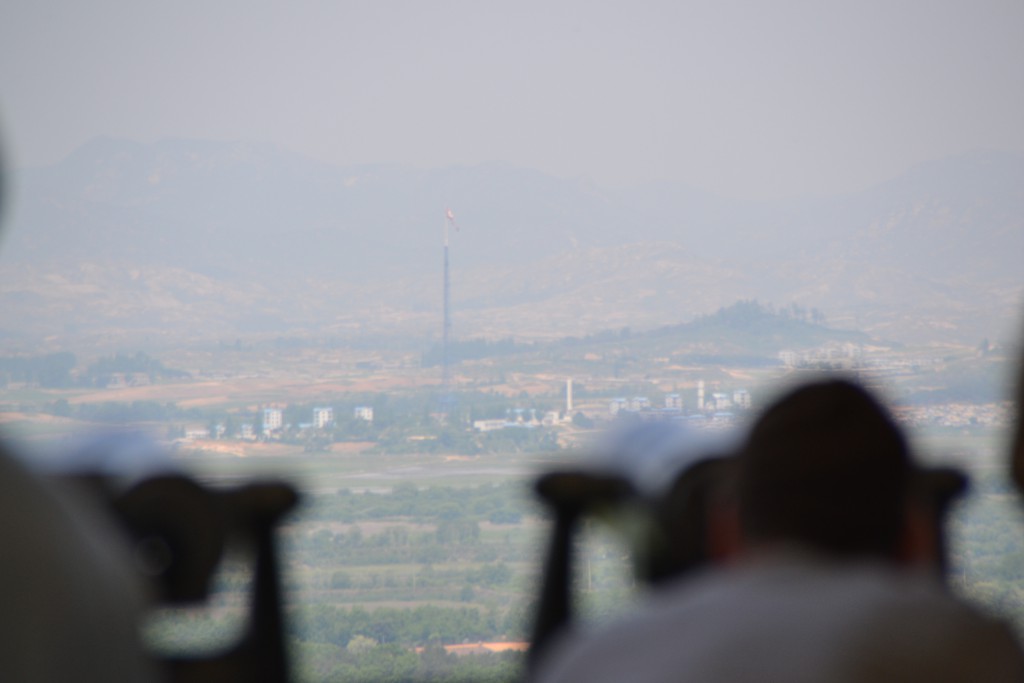
Next part was more interesting though, we went to an observation post at (3) where  one could look into North Korean territory. A showcase village (Kijŏngdong) was erected to give the illusion of a prosperous North Korea, however reports (Wikipedia) say that village is pretty much dead. The famous North Korean flagpole is clearly visible. Regretfully we only had 20 minutes here, again, tons of tourists, and I was so busy taking pictures, I missed the opportunity to try the installed binoculars. (Requires a 500 Won coin, btw.)
Photography was regulated again, and was only allowed outside a yellow line. As far as I could see this prevented tourists to take detailed pictures of the DMZ cordon.

North Korean Kijŏngdong (aka the propaganda village) with its massive flagpole.

A bit further south of it, yet still on North Korean side, the industrial region of Kaesong can be seen. Established during the years of sunshine policy, using cheap North Korean labor force it was allegedly used for economic development of the North. Sunshine policy ended as North Korea tried to establish itself as a nuclear-weapons state, yet the factory is still active. I saw several trucks going from the North to the South at the Dorasan station.

Kaesong industrial region.
The tour was getting more interesting as we approached the South Korean Dorasan railway station.

A young South Korean guard at Dorasan station.
The station is just a few meters of the southern DMZ perimeter. Another mile and you cross the MDL. The station was build with the intention easing the transfer of goods and passengers between the two countries. Since the end of the sunshine policy however this station was only used for bringing tourists from the south to the DMZ. No movements across the MDL.

Tracks leading to North Korea. DMZ fence just visible at the end, blocking the tracks.

Going for a walk along the platform to the north.

This was one minute before a South Korean guard (who followed me all the way up the platform) told me off that that I am walking too far.

Still managed to check the tracks. All rusty, here clearly no train has gone for some time.
Finally the highlight, visiting the Joint Security Area. Our passports got checked again and again passing several checkpoints (no photos!), we were transferred to buses driven by American and Korean soldiers (no photos!). We had to leave our belongings behind. I took a hat with me, but where not allowed to carry it in my hands. Had to wear it all the time. We were brought to a briefing room (no photos!) where we saw a presentation on the history of the JSA. Finally we had to sign a "Visitor Declaration UNC REG 551-1", stating that

"The visit to the Joint Security Area at Panmumjom will entail into a hostile area and possibility of injury or death as a directly result of enemy action.(...) Although being on the alert for unexpected condition, the United Nations Command, the United States of America, and the Republic of Korea cannot guarantee the safety of visitors and may not be held accountable in the event of a hostile enemy act."

It also said that

"2.c. Fraternization, including speaking, gesture or any association with personnel from the Korean People's Army/Chinese People's Volunteers (KPA/CPV) side, is strictly prohibited."
"2.d. Visitors will not point and make gestures or expressions like scoffing, abnormal action which could be used by the North Korean side as propaganda material against the United Nations Command."
"2.f. (...) In any case, there is no drinking alcohol and who is not sober for 12 hours prior to the tour will not be accepted."

After that we were forming a line pairwise, and we were let into the central UNC building, which pretty much is a shabby old makeshift shed.

Facing North Korea, MDL is the concrete block between the blue UNC buildings. The white building behind it is North Korean. They added a third story to it, to make it taller than the South Korean counterpart.
Inside the UNC building you are allowed to cross the MDL, technically being in North Korea then.

This is it: Niels in North Korea. Technically at least.
South Korean guards wearing sunnies and posing in Taekwondo positions are supposed to intimidate North Korean guards. North Korean guards were very scarce that day though, I only saw one.

South Korean guard keeping an eye on the North.

No, this is not Madame Tussauds. Guard is alive, but not moving an inch.
Closeup of the North Korean building where a KPA guard keeps an eye on us. This was the only North Korean guard we saw that day.
The entire tour didn't last long, after 15 minutes or so, we marched back to our buses.
Again, one of the US soldiers was about to tell me off as I moved to far away from the group. (And I was reminded several times that I am not allowed to carry my hat, but must wear it.)
 Back on the JSA bus, we had a quick drive around the JSA side, visiting also the "Bridge of No Return", where the MDL is somewhere on the middle of it. The legend says, anyone crossing the bridge would never return, therefore the name. The entire JSA and even the DMZ is a large natural wilderness, with many rare species after nature was left by itself in the minefields for decades. I was astonished how few clear lines of sight you had while moving in the DMZ or even the JSA.

Bridge of No Return as it is May 2012, photographed from South Korea, facing North Korea. (Happy I got the 200 mm zoom lens the day before in Seoul.) The MDL is somewhere on the middle of the bridge.
Now, that made me think. I grew up and lived 20 years a few meters from the border between Denmark and Germany. 200 meters away from my home, there is a little bridge, where the border between Denmark and Germany is crossing the middle of the bridge, see picture below. So similar, yet so different.

Schusterkate / Skomagerhuset the most eastern part of the Danish - German border. This is the German side, facing Denmark, again the MDL... eeehhh.. the border is somewhere on the middle of the bridge.
Surely, this was the most interesting part of the tour. I flirted with the idea of actually doing one of those arranged North Korean tours which are becoming more and more abundant. However, I must admit, facing 5 days of massive Juche propaganda, putting down flowers at the dear leader and watching an endless list of showcase tourism spots, is a kind of a turnoff.
Guess I had enough for now, in this case I may leave the traveling to others, there are plenty of interesting Videos about North Korea I can watch instead. Here, a few links
  • Monkeetime North Korea - a quite hilarious/sarcastic report of the propaganda tours, in 12 episodes. (Tag line: "If this is a banana republic, where the f*ck are the bananas?")
  • A Documentary from 2005 - lots of smuggled footage. I talked to some South Koreans who actively worked for the reunification of Korea.
    Asking about the famine, one replied: "No, not starving. They are hungry, but not starving."
    Aha.
That's it for now. More pics from Seoul (and the DMZ) can be found here.


Sunday, February 5, 2012

Visiting a Nuclear Research Reactor

This is a continuation of the list "10 things a physicist should have done during his career", which started with the very first post of this blog.

  1. Split an atom
  2. see Cherenkov light

    Now point 3:
  3. operate a nuclear reactor
    (Note, doing this mostly results in fulfilling 1) and 2) )

I had this once-in-a-lifetime chance at our collaborators at the Department of Nuclear Chemistry at the Johannes Gutenberg University in Mainz, where they operate a 100 kW TRIGA mark II research reactor by General Atomics. They have ample amounts of experiments taking place at the reactor and at the neutron beam lines, such as Boron neutron capture therapy (BNCT), research of ultracold neutrons, do trace element analysis of mineral water and even wine.

The institute also offers a hands-on nuclear reactor training courses for students in nuclear chemistry and engineers from various companies (e.g. Areva). August 2011 I had a chance to realize this unique opportunity! I signed up for the 1-week practical course, which introduced me and 9 other (much younger) students to various topics around the nuclear reactor:
  • lectures on reactor physics and radioprotection
  • starting and shutting down check lists
  • calibration of control rods
  • fuel element inspection
  • power regulation
  • reactivity measurements
  • and various neutron activation experiments
It was awesome!

The TRIGA research reactor at Mainz.

First part of the course was to get confident with the infrastructure around the reactor core. Every morning a long check list must be completed before start-up of the reactor. The check list involved a thorough inspection of the cooling circuits, radiation monitors and ventilation system. (It took us 1-2 hours to complete it.)

First page of the check-list which has to be completed and duly signed every morning before the reactor is put into operation.
We checked the power supply and the emergency power supply, double redundant ventilation, primary and secondary cooling circuit (double redundant too), radiation monitors, quality of water, warning systems...

Primary cooling circuit, double redundant. If one pumping chain fails, another takes over.
I was a bit surprised how inconspicuous the heat exchanger was, it's a rather small device. However the reactor does operate with merely 100 kW at maximum, so the amount of heat is really limited.

The heat exchanger is seen to the left. It interfaces the primary (marked with red labels) and the secondary cooling circuit (marked with blue labels).

Apart of the regular checks, the course also involved some other tests, such as quality control and inspection of fuel elements, several types of sample irradiation as well as calibration of neutron detectors and other reactor parameters.

The reactor core viewed from the platform on top of the reactor structure. Water is about 6 meters deep.
In the picture above, several tubes and rods can be seen sticking into the core. There are three control rods, two which adjust the power of the reactor and a third rod which is used for pulsed operation of the reactor. Several additional tubes are used for sample transport. Four horizontal beam lines (also visible in the picture above) are available for neutron extraction, and a special channel provides thermal neutrons for e.g. the BNCT experiments.
In between the long rods the fuel elements can be seen. A 30 cm thick graphite reflector surrounds the core.

Gone fishing. Here I try to put an Americium-Beryllium neutron source next to one of the neutron counters for a calibration test.
The water in the reactor pool has extremely high purity, and does not contain any trace elements which can become activated. Therefore no gloves are necessary when messing around with reactor pool water.

Using a waterproof video camera, we could visually inspect details of the reactor core, while it was shut down. In the picture below the top of some fuel elements can be seen and one of the control rods to the left.
Fuel elements are categorized as low-enriched or high-enrighed uranium (LEU or HEU, respectively). High enriched material is difficult to handle bureaucratically, since it is potentially weapons grade quality.  The fuel elements at TRIGA reactors are all LEU, but enriched to the maximum allowed ~20% Uranium 235. As a comparison, fuel elements for normal power production are enriched to about 5% U-235. A few grams of weapon grade uranium are still used for the neutron detectors.

We were allowed at some point to hold an unused fuel element, which are about 70 cm long, diameter of 4 cm. They are not "hot" in either sense, but pretty heavy for their size. When tilting them you can hear the Uranium elements moving inside. Some of the fuel elements they store were from the decommissioned neutron cancer therapy project at the German Cancer Research Center in Heidelberg (DKFZ), I remember I had my office just next to the reactor building while I worked there. As the fuel elements deteriorate, they increase in length which is carefully logged. When the length increase is goes beyond a threshold, or if any other defects are visible, the fuel elements will be replaced. (The price of one fuel element is comparable with that of a sports car.)


Visual inspection of the reactor core with a waterproof video camera mounted on a 6 meter long stick which is immersed into the reactor pool. The top of four fuel elements are visible in the foreground. Note the sporadic white pixels in the screen which is caused by gamma photons from the radiation from the decay of the activated metal structure.

We all learned how to start and shut down the reactor. Operation happens from a control panel with very nice analog dials and buttons. I just love that!


In particular I found it interesting to get a feeling of how the power and neutron fluxes change as you adjust the control rods. It is a very non linear system with hysteresis in the sense that a state at a given configuration depends on how the reactor was operated before. Power drops due to reactor poisoning as a function of time, which again is compensated by extracting the control rods. Eventually an equilibrium is established.

Samples to be irradiated are transported with a pneumatic system to the reactor core.

Once the reactor is operating in continuous mode, samples can be inserted into the core, which are irradiated with high neutron fluences. Afterwards the produced nuclei can be measured by gamma-ray spectroscopy.

Control panel for the reactor. The three control rods are operated by the three button groups
in the center of the panel. Left is the pulse rod, then there are two additional rods for coarse and fine tuning the desired reactor power. Here both the coarse and fine tuning control rods are extracted half way. (Or half inserted, depending on what kind of person you are.)

Prior pule operation, the reactor is put to 50 W level (i.e. producing less heat than a conventional light bulb). Pulse operation involves that one of the control rods (the “pulse rod”, specially designed for this purpose), is shot out of the core. The reactor becomes promptly critical, reaching a few megawatt for a split second, but due to the negative temperature coefficient of the reactor, the heat immediately makes the reactor sub-critical again. The result is a short intense spike of neutrons which is used for various experiments, and beautiful flash of Cerenkov radiation.


The negative temperature coefficient is a special feature of TRIGA reactors, which make them particularly safe to work with, since they simply cannot  meltdown. Any nuclear reaction simply stops if the temperature of the fuel elements goes above a few 100 degrees C.

Anyway, this was a very interesting course, I framed in the diploma I got, its hanging in my office. :)

Wednesday, January 25, 2012

Tripoint Borders II: Slovakia, Hungaria and Austria

After the first tripoint border post where Germany meets Poland and the Czech republic I will now go a bit further south. Summer 2011 I visited colleagues in Bratislava, and took a look on a primary standard dosimetry laboratory. I stayed in a little village south of Bratislava called Čunovo [Tschoo-no-vo]. I knew the Austrian border was just a few kilometers upstream the Danube river, but what I did not realize was, how close I was to the Hungarian border as well. It was just a few 100 meters away, which I found out when I got back to Aarhus, and checked my maps. The border tripoint was just 2 km east.
I missed it, unknowingly. Bummer.

Bad luck, but fortunately I got a second chance. In November I was in Čunovo again, and I convinced my friends to take me to the border tripoint (they've been living 20 years in Čunovo, but have never vistied the tripoint themselves. How can anyone be not as geeky as me?).


View Tripoint: AT, SK, HU in a larger map

So we took their dog for a walk (a black and rather friendly minded Labrador, who occasionally reacts on the name "Arwi" and to various goodies).
Eva, Tibor and Linda (who doesn't live in Čunovo, but Melbourne, Australia - the country WITH kangaroos), clearly thinking "why do we have to go here, where is he taking us". Arwi, the friendly black Labrador, is obviously fine with it.

The Hungarian-Slovakian border was interesting, a true prototype checkpoint, almost taken out of a Tintin Hergé comic.

Just crossed the border, this is on the Hungarian side, facing north, to Slovakia. The checkpoint building seemed to be unoccupied for years. In the electric lines over the rail tracks to the left there is a small square sign which indicates an upcoming interruption in the power supply. Yeah, I pay attention to such weird details.

I've only been once to Hungary during the solar eclipse in 1999, (Kiskunhalas, a real tourist trap!). Language is totally incomprehensible, here I am obviously approaching the "Magyar Köztársagág".


Yeah, Köztársaság, bring it on!

.

Half of me in Slovakia, other part in Hungary. (Clothes borrowed from Tibor, thanks. Linda spilled carbonated drinks all over me in the plane to Vienna and I smelled like a brewery.)

Sun setting in the west (no kidding), along the Slovak/Hungarian border. Austria (that country WITHOUT kangaroos) at the horizon.
The countryside is flat, almost "Nordfriesland" like (close to where I grew up), which is also pan-cake flat like. Just without the sheeps and cattle. And the sea. And the miserable gray weather.

After a 20 min walk we reached the tripoint.

That's it! The white pillar marks the tripoint. Standing in Austria "Ö" (NO kangaroos), facing east, Hungary "M" to the right, Slovakia in the background.

Triplex point.
Very little was left from the original border from the pre-Schengen era.

A piece of the original barbered wire fence between Slovakia and Hungary.
Around the tripoint a few art installations could be found. Various rocks were scattered around, shaped and piled in different ways. In the left side of the picture above you may recognize a flat rock. I have no picture of its surface, but it was triangular with many alien-like hieroglyphs across it.

Update: got it (thanks again, Tibor)...
 
Hmm..?
There seems to be some kind of link between Bratislava and aliens. Think also of the top restaurant of the "Novy Most" (= "new bridge") over the Danube: it is UFO shaped, and I'm sure it can detach from the bridge if necessary. (:)|-<

Navigation aid for aliens. Get the idea? I feel a conspiracy uncovering.
The (still friendly minded) Labrador Arwi was more into chasing rabbits in the fields. Both the rabbits and Arwi crossed borders multiple times during the chase, underlining that borders are a creation of human minds, not of those of dogs and rabbits (or aliens).

There are "Pozor"s in the field. Beware.


Certainly worth going there, so thanks to Eva, Tibor and Linda for being patient with me, and Arwi for being the friendly black Labrador she is.
(Arvi missing, found another rabbit.)

All photos made with crappy mobile phone camera, more weird photos may be discovered here.