Опасная зона

Опасная зона

Sunday, February 5, 2012

Visiting a Nuclear Research Reactor

This is a continuation of the list "10 things a physicist should have done during his career", which started with the very first post of this blog.

  1. Split an atom
  2. see Cherenkov light

    Now point 3:
  3. operate a nuclear reactor
    (Note, doing this mostly results in fulfilling 1) and 2) )

I had this once-in-a-lifetime chance at our collaborators at the Department of Nuclear Chemistry at the Johannes Gutenberg University in Mainz, where they operate a 100 kW TRIGA mark II research reactor by General Atomics. They have ample amounts of experiments taking place at the reactor and at the neutron beam lines, such as Boron neutron capture therapy (BNCT), research of ultracold neutrons, do trace element analysis of mineral water and even wine.

The institute also offers a hands-on nuclear reactor training courses for students in nuclear chemistry and engineers from various companies (e.g. Areva). August 2011 I had a chance to realize this unique opportunity! I signed up for the 1-week practical course, which introduced me and 9 other (much younger) students to various topics around the nuclear reactor:
  • lectures on reactor physics and radioprotection
  • starting and shutting down check lists
  • calibration of control rods
  • fuel element inspection
  • power regulation
  • reactivity measurements
  • and various neutron activation experiments
It was awesome!

The TRIGA research reactor at Mainz.

First part of the course was to get confident with the infrastructure around the reactor core. Every morning a long check list must be completed before start-up of the reactor. The check list involved a thorough inspection of the cooling circuits, radiation monitors and ventilation system. (It took us 1-2 hours to complete it.)

First page of the check-list which has to be completed and duly signed every morning before the reactor is put into operation.
We checked the power supply and the emergency power supply, double redundant ventilation, primary and secondary cooling circuit (double redundant too), radiation monitors, quality of water, warning systems...

Primary cooling circuit, double redundant. If one pumping chain fails, another takes over.
I was a bit surprised how inconspicuous the heat exchanger was, it's a rather small device. However the reactor does operate with merely 100 kW at maximum, so the amount of heat is really limited.

The heat exchanger is seen to the left. It interfaces the primary (marked with red labels) and the secondary cooling circuit (marked with blue labels).

Apart of the regular checks, the course also involved some other tests, such as quality control and inspection of fuel elements, several types of sample irradiation as well as calibration of neutron detectors and other reactor parameters.

The reactor core viewed from the platform on top of the reactor structure. Water is about 6 meters deep.
In the picture above, several tubes and rods can be seen sticking into the core. There are three control rods, two which adjust the power of the reactor and a third rod which is used for pulsed operation of the reactor. Several additional tubes are used for sample transport. Four horizontal beam lines (also visible in the picture above) are available for neutron extraction, and a special channel provides thermal neutrons for e.g. the BNCT experiments.
In between the long rods the fuel elements can be seen. A 30 cm thick graphite reflector surrounds the core.

Gone fishing. Here I try to put an Americium-Beryllium neutron source next to one of the neutron counters for a calibration test.
The water in the reactor pool has extremely high purity, and does not contain any trace elements which can become activated. Therefore no gloves are necessary when messing around with reactor pool water.

Using a waterproof video camera, we could visually inspect details of the reactor core, while it was shut down. In the picture below the top of some fuel elements can be seen and one of the control rods to the left.
Fuel elements are categorized as low-enriched or high-enrighed uranium (LEU or HEU, respectively). High enriched material is difficult to handle bureaucratically, since it is potentially weapons grade quality.  The fuel elements at TRIGA reactors are all LEU, but enriched to the maximum allowed ~20% Uranium 235. As a comparison, fuel elements for normal power production are enriched to about 5% U-235. A few grams of weapon grade uranium are still used for the neutron detectors.

We were allowed at some point to hold an unused fuel element, which are about 70 cm long, diameter of 4 cm. They are not "hot" in either sense, but pretty heavy for their size. When tilting them you can hear the Uranium elements moving inside. Some of the fuel elements they store were from the decommissioned neutron cancer therapy project at the German Cancer Research Center in Heidelberg (DKFZ), I remember I had my office just next to the reactor building while I worked there. As the fuel elements deteriorate, they increase in length which is carefully logged. When the length increase is goes beyond a threshold, or if any other defects are visible, the fuel elements will be replaced. (The price of one fuel element is comparable with that of a sports car.)


Visual inspection of the reactor core with a waterproof video camera mounted on a 6 meter long stick which is immersed into the reactor pool. The top of four fuel elements are visible in the foreground. Note the sporadic white pixels in the screen which is caused by gamma photons from the radiation from the decay of the activated metal structure.

We all learned how to start and shut down the reactor. Operation happens from a control panel with very nice analog dials and buttons. I just love that!


In particular I found it interesting to get a feeling of how the power and neutron fluxes change as you adjust the control rods. It is a very non linear system with hysteresis in the sense that a state at a given configuration depends on how the reactor was operated before. Power drops due to reactor poisoning as a function of time, which again is compensated by extracting the control rods. Eventually an equilibrium is established.

Samples to be irradiated are transported with a pneumatic system to the reactor core.

Once the reactor is operating in continuous mode, samples can be inserted into the core, which are irradiated with high neutron fluences. Afterwards the produced nuclei can be measured by gamma-ray spectroscopy.

Control panel for the reactor. The three control rods are operated by the three button groups
in the center of the panel. Left is the pulse rod, then there are two additional rods for coarse and fine tuning the desired reactor power. Here both the coarse and fine tuning control rods are extracted half way. (Or half inserted, depending on what kind of person you are.)

Prior pule operation, the reactor is put to 50 W level (i.e. producing less heat than a conventional light bulb). Pulse operation involves that one of the control rods (the “pulse rod”, specially designed for this purpose), is shot out of the core. The reactor becomes promptly critical, reaching a few megawatt for a split second, but due to the negative temperature coefficient of the reactor, the heat immediately makes the reactor sub-critical again. The result is a short intense spike of neutrons which is used for various experiments, and beautiful flash of Cerenkov radiation.


The negative temperature coefficient is a special feature of TRIGA reactors, which make them particularly safe to work with, since they simply cannot  meltdown. Any nuclear reaction simply stops if the temperature of the fuel elements goes above a few 100 degrees C.

Anyway, this was a very interesting course, I framed in the diploma I got, its hanging in my office. :)

Wednesday, January 25, 2012

Tripoint Borders II: Slovakia, Hungaria and Austria

After the first tripoint border post where Germany meets Poland and the Czech republic I will now go a bit further south. Summer 2011 I visited colleagues in Bratislava, and took a look on a primary standard dosimetry laboratory. I stayed in a little village south of Bratislava called Čunovo [Tschoo-no-vo]. I knew the Austrian border was just a few kilometers upstream the Danube river, but what I did not realize was, how close I was to the Hungarian border as well. It was just a few 100 meters away, which I found out when I got back to Aarhus, and checked my maps. The border tripoint was just 2 km east.
I missed it, unknowingly. Bummer.

Bad luck, but fortunately I got a second chance. In November I was in Čunovo again, and I convinced my friends to take me to the border tripoint (they've been living 20 years in Čunovo, but have never vistied the tripoint themselves. How can anyone be not as geeky as me?).


View Tripoint: AT, SK, HU in a larger map

So we took their dog for a walk (a black and rather friendly minded Labrador, who occasionally reacts on the name "Arwi" and to various goodies).
Eva, Tibor and Linda (who doesn't live in Čunovo, but Melbourne, Australia - the country WITH kangaroos), clearly thinking "why do we have to go here, where is he taking us". Arwi, the friendly black Labrador, is obviously fine with it.

The Hungarian-Slovakian border was interesting, a true prototype checkpoint, almost taken out of a Tintin Hergé comic.

Just crossed the border, this is on the Hungarian side, facing north, to Slovakia. The checkpoint building seemed to be unoccupied for years. In the electric lines over the rail tracks to the left there is a small square sign which indicates an upcoming interruption in the power supply. Yeah, I pay attention to such weird details.

I've only been once to Hungary during the solar eclipse in 1999, (Kiskunhalas, a real tourist trap!). Language is totally incomprehensible, here I am obviously approaching the "Magyar Köztársagág".


Yeah, Köztársaság, bring it on!

.

Half of me in Slovakia, other part in Hungary. (Clothes borrowed from Tibor, thanks. Linda spilled carbonated drinks all over me in the plane to Vienna and I smelled like a brewery.)

Sun setting in the west (no kidding), along the Slovak/Hungarian border. Austria (that country WITHOUT kangaroos) at the horizon.
The countryside is flat, almost "Nordfriesland" like (close to where I grew up), which is also pan-cake flat like. Just without the sheeps and cattle. And the sea. And the miserable gray weather.

After a 20 min walk we reached the tripoint.

That's it! The white pillar marks the tripoint. Standing in Austria "Ö" (NO kangaroos), facing east, Hungary "M" to the right, Slovakia in the background.

Triplex point.
Very little was left from the original border from the pre-Schengen era.

A piece of the original barbered wire fence between Slovakia and Hungary.
Around the tripoint a few art installations could be found. Various rocks were scattered around, shaped and piled in different ways. In the left side of the picture above you may recognize a flat rock. I have no picture of its surface, but it was triangular with many alien-like hieroglyphs across it.

Update: got it (thanks again, Tibor)...
 
Hmm..?
There seems to be some kind of link between Bratislava and aliens. Think also of the top restaurant of the "Novy Most" (= "new bridge") over the Danube: it is UFO shaped, and I'm sure it can detach from the bridge if necessary. (:)|-<

Navigation aid for aliens. Get the idea? I feel a conspiracy uncovering.
The (still friendly minded) Labrador Arwi was more into chasing rabbits in the fields. Both the rabbits and Arwi crossed borders multiple times during the chase, underlining that borders are a creation of human minds, not of those of dogs and rabbits (or aliens).

There are "Pozor"s in the field. Beware.


Certainly worth going there, so thanks to Eva, Tibor and Linda for being patient with me, and Arwi for being the friendly black Labrador she is.
(Arvi missing, found another rabbit.)

All photos made with crappy mobile phone camera, more weird photos may be discovered here.

Wednesday, January 11, 2012

Tripoint Borders I: Germany, Poland, Czech Republic

In Europe there are plenty of border tripoints, and I have a long term plan to visit them all. Or, after realizing some may require some serious mountain climbing, at least most of them.
It should be a rather easy task for most points though, they are not guarded in any way, due to the Schengen agreement. This post is about the first one I visited back in 2008 or so. Here the borders of Poland, Germany and the Czech republic meet. I had some time off in Dresden, so I took a local train to Zittau. The train ride was an hour or so, and quite interesting, stopping on "wild west" like villages (in eastern Germany. Right.) mostly going parallel with the German side on the Czech-German border. At one point the tracks of Deutsche Bahn cross into the Czech republic for a few 100 meters, just south of the village Oppach. This area is also known as "Fugauer Zipfel" where once a Bohemian village "Fukov" existed. During the 50'ies there were some unsuccessful attempts by the GDR to swap the area.


View Larger Map

Arrived at Zittau railway station, the tripoint is about 40 min walk way. The tripoint is best reached from the Polish or Czech side.
Border checkpoint Germany/Poland.

I crossed the border from Germany to Poland at a checkpoint "Friedensstraße", and walked south along the Lusatian Neisse (Lausitzer Neiße) river.


First time in Poland. Sign tells you to beware of the "Pozor"s..
I've been to most countries in Europe, but strangely enough, this should be the first time I enter Poland.


View 50.870328, 14.823275 in a larger map

The triplex point is in the middle of the Neisse river which divides south western Poland and eastern Germany.
A closed bridge. Poland here, Germany there.


There is also a very small stream which separates Poland from the Czech republic, small enough you can just step over it.

Facing south, a corner of the Czech republic. Poland is the bit of grass to the lower left. Germany is out of sight on the right side of the Neisse river.

Border stone separating Poland from the Czech republic. Seems the D was changed into a P.
Standing on the Czech side, facing north. The small white and the larger monument to the right is entirely on the Czech side.

The actual tripoint is inaccessible, unless you are prepared to get wet feet.
Standing on the Czech side. The green grass to the upper left is in Germany, and plants on the right side are Polish. The actual tripoint is somewhere in the river above my head.
Water looked too cold, I didn't want to overdo things.
Complete gallery on Picasa.

Coming up, pics from the tripoint at Austria, Slovakia and Hungary.

Sunday, October 16, 2011

A Tour of the Tandem EN Accelerator in Aarhus

As I mentioned earlier we have several particle accelerators at the Department of Physics and Astronomy in Aarhus. After showing our little KN Van de Graaff from HVEC, this post is dedicated to our 5 MV EN Tandem, which recently suffered irreparable damage after a series of indoor explosions.


The EN Tandem is the smaller brother of the FN Tandem by HVEC. Our EN was installed in Aarhus during the early 70ies. Our tour today starts in the control room of the accelerator:

Main control room.
The panel shows an outline of the facility. Beam starts in one of the two ion sources to the right, the accelerator in the center, energy selection magnet to the left, and finally the beam selection magnet to the lower left.

Ion source controls.
When starting the accelerator, you first turn on the power for the control system with the key in the upper right. Fire up the ion source (filament, sputtering and oven current) or if you are running a gas source, increase the gas pressure. Then make sure you get a beam out of the ion source.

Injector controls.
The ion sources are lifted to some negative high voltage, such as -70 kV. You can control the voltage with the upper right dial. The blue panels are new controls which were designed in-house by the accelerator engineer Klaus Bahner, who gradually upgraded the old technology.

The inflection magnetic field directs the beam from the active ion source to the Tandem accelerator. Addiational a chopper was there for attenuating the beam, along with electrostatic beam steerers. Two quadrupole pairs assures the focusing of the beam.

Beam current monitors.
Of course, you must somehow get an idea if you have a beam or not. Several destructive monitors can be inserted into the beam. The measured current could be coupled with a speaker, where the pitch of the tone was proportional with the current. This way you could concentrate on tuning the beam on the most optimal setting without constantly staring at the amperemeter. This feature was used a lot, as you can see in the picture above the text for setting the speaker volume is worn off.

Accelerator controls.
The Tandem accelerator itself is controlled with the panels shown above. Here you find the switches for the belt motor and the charge supply, which sprays charge on the belt. The terminal voltage could be adjusted with the "charge current" button and further stabilized with the "corona distance".
Inside the terminal you can install several kinds of strippers, either a gas stripper, or various foil strippers. The negative ions are here stripped by their electrons, then becoming positive and accelerated again from the positively charged terminal.

Analyzer magnet controls.
The accelerated beam leaving the Tandem may contain several ion types. With the analyzer magnet you can select the beam you want.

Beamline selection and focussing.

And finally, after some additional tuning and focussing, you can select which beam line you want to use.
Control logic
Safety system bypass switches...

This concludes our tour in the control room, next lets take a look at the accelerator vault. Depending on what kind of ion and what currents you operate with, the accelerator may create radiation. Mostly gammas, but occasionally also neutrons if you run e.g. high current protons. A massive concrete door slides aside...


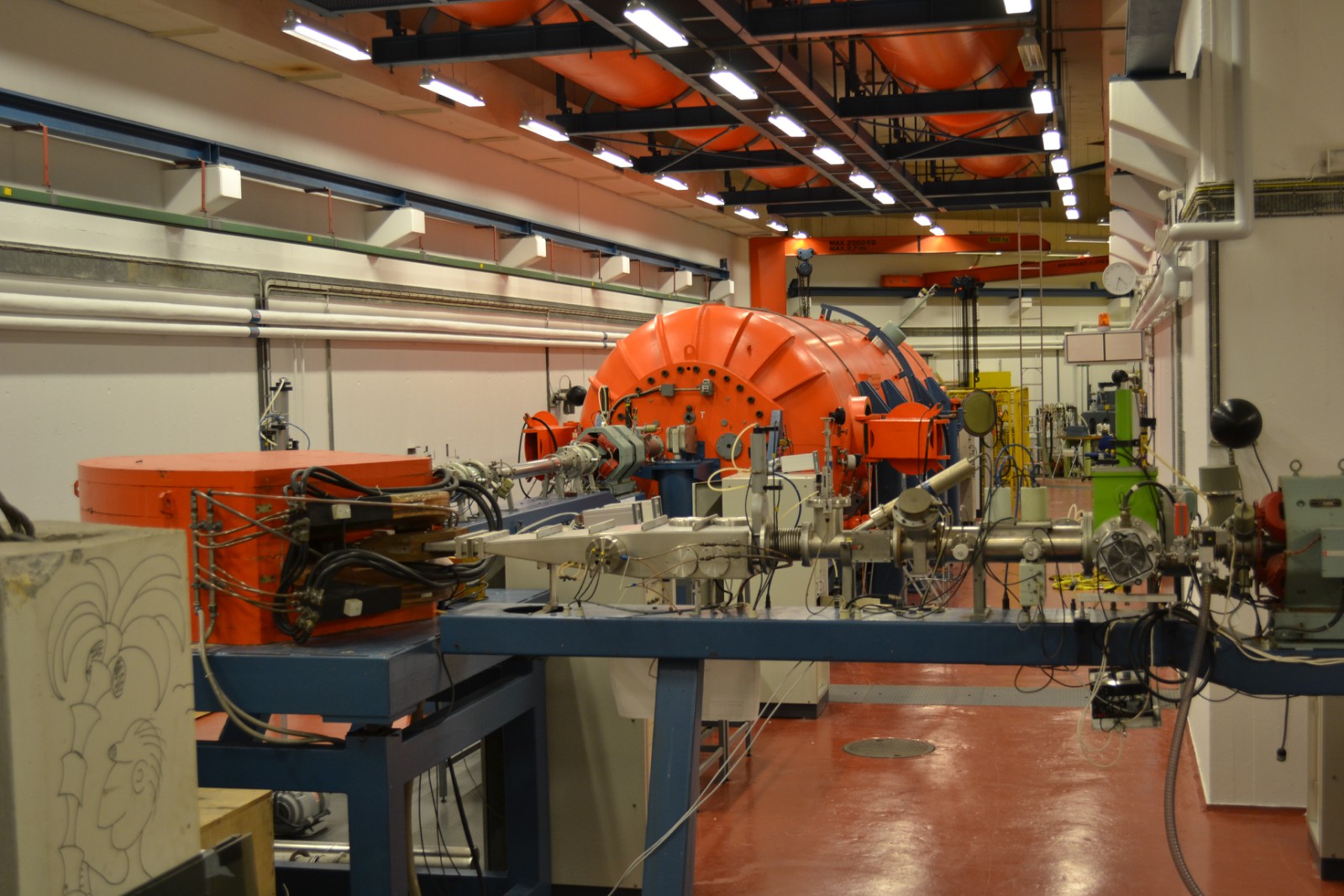
Once inside, you can see the Tandem accelerator (to the left) and the two ion sources to the right.


The ion source to the back next to the blue 19' rack, is a new ion source for C-14 dating. It contains a large wheel with dozens of carbon samples to be measured for C-14 contents. Also an airlock makes it possible to change the samples without breaking the vacuum.


Here is the old C-14  ion source which was used for many years. Both the new and the old ion source is a sputter ion source where Cesium ions are bombarding the carbon target, thereby releasing negatively charged ions.


The accelerator itself is a big pressurized tank containing a vaccum tube and the high voltage charging apparatus. The tank is filled with mix of dry Nitrogen and SF6 (stored in the tanks under the ceiling). Due the damage the accelerator suffered, it was depressurized for further inspections. So let's have a look inside...


Before you enter, you must make sure that proper venting is assured. There has been a casualty at another accelerator of this type, where people fainted and suffocated.


There are four manholes, where you can enter. You can see the ring structures which ensure a homogenous field gradient from the high voltage terminal.


Looking from the low energy section to the high energy section, you can just glimpse the terminal in the middle.


A part of the acceleration tube at the high energy section.

Once the beam exits the accelerator, it passes a quadrupole pair... 


... and the orange analyzing magnet shown to the left.


Finally it passes another set of quadrupoles and the switching magnet, which directs the beam to one of the 8 beam lines.


Magnets are water cooled.


A water cooled beam dump.

Radiation detectors monitor the gamma and neutron field in the accelerator vault.


Signs tell if the accelerator is running, and if radiation is present.

Hand held radiation monitors.
The sad story is that due to some renovation of nearby labs, it was decided to destroy two other radiation protection doors (of similar type like the ones shown before) with dynamite. Unfortunately the five explosions set off a blast wave which destroyed the Tandem beyond repair. The pressure tank took damage, and cannot be repressurized, the accelerating column is bent downwards and there are many other issues.

A movie of the explosion of one of the two radiation protection doors can be seen here:
http://owww.phys.au.dk/main/historie/blast002.avi

A damage report (in Danish only, but with fancy pictures) is here:
http://ing.dk/modules/fsArticle/download.php?fileid=968

This is the end of our tour at the Tandem accelerator.
The complete picture gallery with additional fotos was uploaded to picasa:
https://picasaweb.google.com/niels.bassler/TandemENAcceleratorAarhus?authuser=0&feat=directlink
If you are still reading this, you are welcome to drop by for a cup of coffee in my office upstairs.. :-)